Windstar Cruises started more than 40 years ago with sailing ships that carried about 150 guests. Its fleet will reach eight ships when the all-suite Star Explorer arrives in a few weeks, but Windstar is keeping its ships small. Other small-ship cruise lines are raising the passenger counts on their vessels, while Star Explorer will carry 224 guests.
Janet Bava is Windstar's chief commercial officer, overseeing marketing, sales, the contact center, revenue management, and itinerary planning, after leading marketing at AmaWaterways and Silversea.
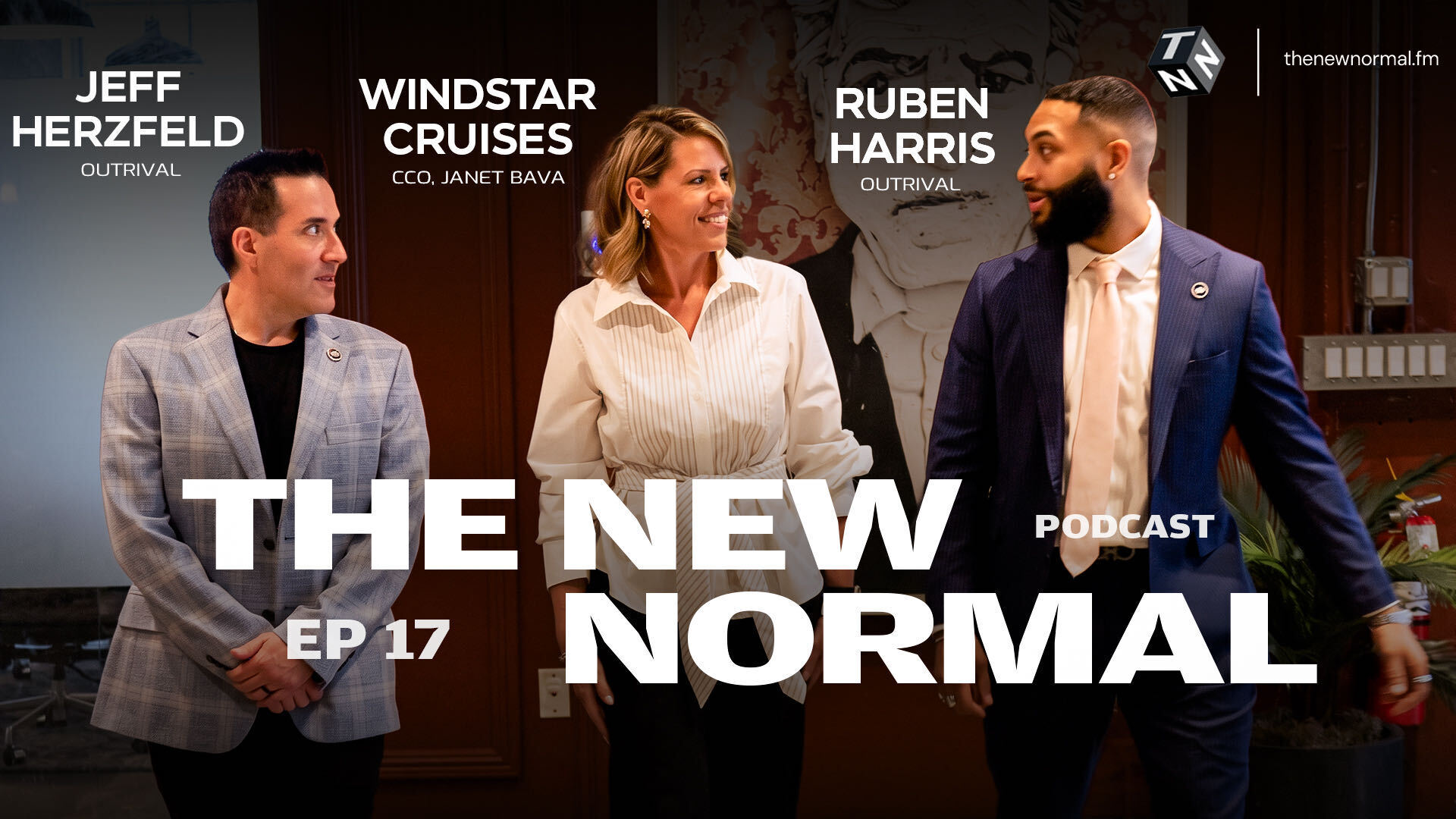
Bava is the 17th guest on The New Normal, OutRival's interview series with leaders deploying AI in production. The conversation, recorded at OutRival's Miami headquarters, covers how Windstar held on to booked revenue during a geopolitical shock, why she treats technology as a revenue investment, and how she wants AI to change the way her salespeople spend their day.
Here are the five biggest takeaways from her conversation with OutRival co-founder Rubén Harris and head of travel Jeff Herzfeld.
1. A booking is not revenue until the guest sails
Windstar entered 2026 with about 80% of the year’s revenue already booked. Then war broke out in the Strait of Hormuz in March, fuel prices spiked, and bookings slowed as guests who had reserved a year or two earlier started asking whether they should still go.
Windstar could see why in its contact center. Supervisors there used to listen in and pick out 10 or 12 calls to review, but with AI now running across the contact center, Windstar can see what every caller is saying. Those conversations showed that guests were canceling over airfare. A flight budgeted at $2,000 was suddenly $4,000, or $8,000 for a couple. “You know what? I’m postponing that cruise,” Bava says, describing the guest’s reasoning.
Windstar answered that concern with a Peace of Mind program. Guests could make their final payment, which normally makes a booking non-refundable, and still move to a full credit if the airfare didn’t work out closer to the sailing date. Keeping those bookings mattered, because losing them would have meant reselling the same suites two or three times, “and now your costs go through the roof.”
2. Technology is for making money, and it is never cheap
When Bava hears leaders talk about using technology for savings, she says “that’s when I know they’ve got it all wrong.”
Technology can make Windstar more profitable and help it scale, she says, “but it’s never something that’s going to be cheap.” New tools usually have to be integrated with other systems, those systems need upgrades, and something eventually breaks. “You don’t launch a website and then move on,” she says. She compares it to an iPhone that, three or four years in, can no longer handle the latest software.
Because the costs keep coming, Bava has to keep making the case to Windstar’s CFO for why technology spending rises and what it returns. She aligns with leadership and with her chief commercial officer counterpart at parent company Xanterra Travel Collection before any request reaches the CFO, and she makes sure earlier projects were delivered before asking for new ones.
Subscribe to The New Normal here.
3. Move salespeople from servicing to selling
Herzfeld calls it the 72% problem: salespeople spend most of their time on service work like collecting final payments and preferences, and a small share actually selling.
Bava wants AI to qualify leads and gather information so that a sales rep talking to a guest or a travel advisor already knows who that person is, and to take over the service tasks. Windstar's new sales operations director told Bava that the team is full of passionate people whose time goes to repetitive work.
"Time is money," Bava says. A seller who flips from 70% service to 70% selling converts more, brings in more revenue, and gets more fulfillment out of the job. On board, dining room crew now send orders to the kitchen by tablet, which leaves them more time with guests. Bava calls the crew the number one reason guests keep coming back.
4. All roads lead to IT
At her 30-day check-in after joining in 2023, Windstar president Chris Prelog asked Bava what she needed to hit aggressive revenue goals. "Honestly, all roads lead to IT," she told him. "You can run the company off of an Excel sheet when you have three ships. You can't do that when you're now a six-ship company going into eight."
Windstar has since prioritized its website, the brand's first impression, and then a CRM shared by every department. Training comes with it: "If you don't train your people to adopt the technology, it's as good as nothing."
Bava also wants IT, the business, and the vendor planning together from the budget stage onward. When they work in silos, each side blames the other, and Bava says no budget can rescue a project run that way. “You can have all the money in the world, it just doesn’t work.”
5. Pick a few use cases and stay aligned
Bava's advice to other executives exploring AI: "Don't bite more than you can chew." Choose a small number of use cases with the greatest impact, which for her means filling the funnel, converting prospects, and delighting guests. Much of what leaders hear is lead generation for whoever is selling the AI bot, she says. "So don't listen to the hype."
Windstar applies the same discipline across its parent company, Xanterra Travel Collection. The brands, each with its own president, chose their CRM and contact center AI vendors together, which costs less and fits the IT services they already share.
Listen to the episode
Check out the full episode to hear:
- Why she thinks wave season no longer exists, and how Windstar creates its own booking waves
- The offer guests get right before they leave the ship, and why travel advisors love it
- How Windstar replaced a departing copywriter with an AI copywriter for every marketing channel leader
- Her first cruise, which was her quinceañera
- Why she predicts luxury will come to mean being disconnected